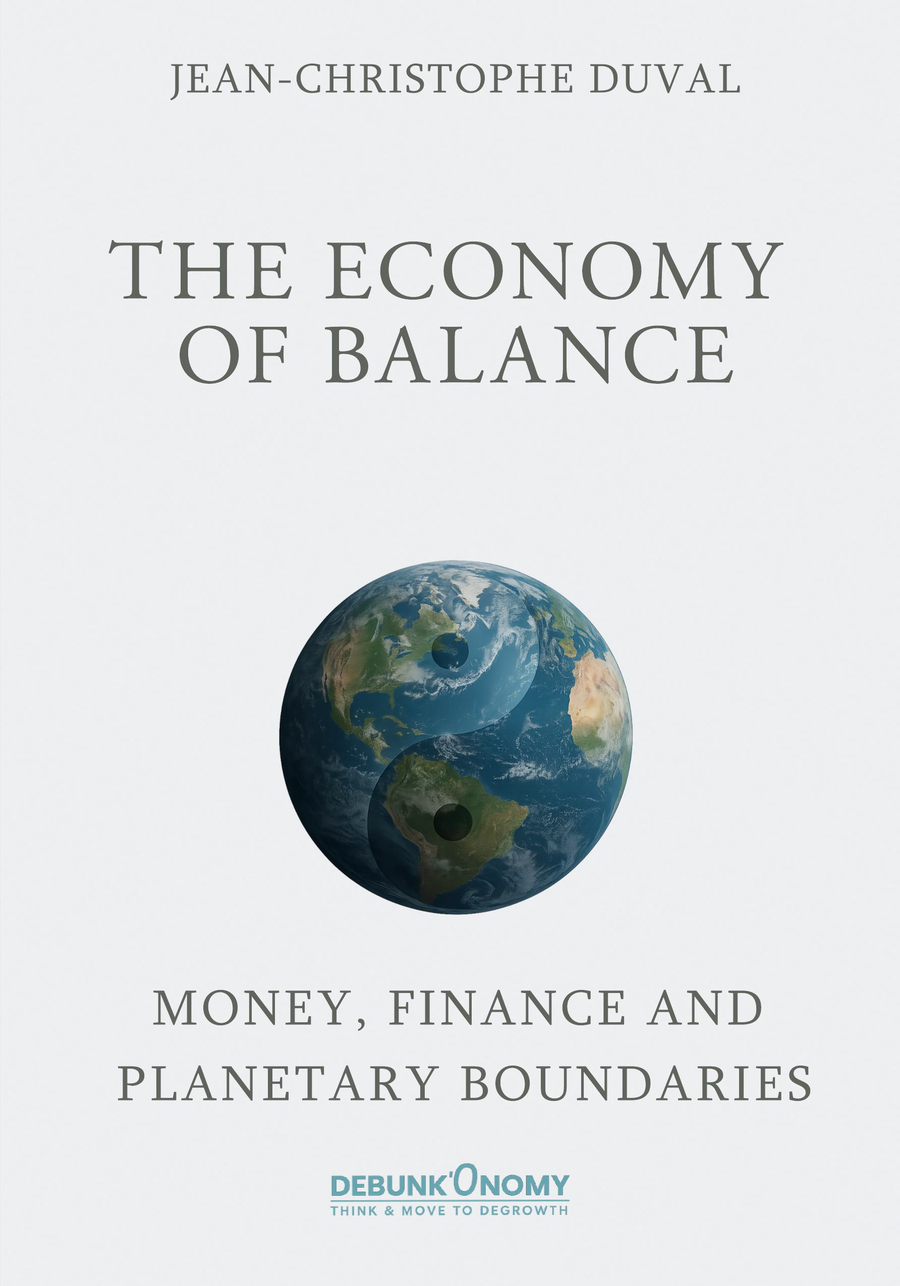
Essay · PDF · June 2026
The Economy
of Balance
Money, Finance and Planetary Boundaries.
- Author
- Jean-Christophe Duval
- Publisher
- Debunk'Onomy
- Pages
- 269
- Format
- PDF download
- Price
- 9.90 €
- ISBN
- 979-10-981064-2-2
Money, Finance and Planetary Boundaries.
The intellectual backbone of the book, formulated for the curious mind and the impatient reader.
Ten chapters, 269 pages. From the critique of the debt-money system to the complete architecture of NEMO IMS.
Sets the diagnosis: the ecological crisis is first and foremost monetary. Introduces the taboo word — degrowth — and distinguishes it from its euphemisms (transition, sobriety, green growth). Presents NEMO IMS as a refoundation of the monetary system rather than yet another reform.
An opening metaphor to understand NEMO IMS. The principle of dual Yin/Yang finance. The three fundamental pillars of robustness, set against the three dogmas of the dominant economy.
A Metaphor to Understand NEMO IMS · Liberating the Living World from Financial Servitude · The Three Pillars of Robustness
Case studies: fast fashion, extractive industries, the contradictions of the energy transition. Why conventional responses are structurally incapable of solving structural crises.
The most substantial chapter in the book. How we moved from money-as-tool to money-as-debt. A mapping of the major monetary theories (neoclassical, post-Keynesian, institutionalist, MMT) and their ecological blind spots.
A Degenerative Paradigm · Cross-Perspectives and Ideologies · Dilemmas Without Money, Dilemmas With Money
The building metaphor: we demolish the foundations to add new floors in homage to GDP. A critique of economic value that ignores "the things we never count."
Three structural paradoxes of the current financial system: bank money creation mechanically manufactures extraction; profitability and regeneration are incompatible; financial debts and planetary debts form a Gordian knot.
The diagnosis of an obsolete economic system, and the outline of a monetary institution dedicated to financing the regeneration of the living world. The "Sisyphean curse" of public debt.
The architectural heart of the proposal. A global governance of planetary commons, and the seven revolutions that accompany it: economic, monetary, financial, of work and merit, legal, accounting, banking.
An exchange standard based on ecological impact rather than on power relations between currencies. Gradually breaking free from dependence on hegemonic currencies without replacing them with another hegemony.
The technical mechanics. A monetary thermodynamics, the "mixer" metaphor between hot money (bank, extractive) and cold money (regenerative). Required reserves, differentiated melt rates, NEMO Green SDRs.
Three scenarios for the advent of NEMO IMS: transformation through global institutions (IMF, BIS, UN); a coalition of pioneer states, modeled on the euro or the BRICS; democratic pressure carried by ecological political movements.
Over thirty pages of critical apparatus: bibliographic references, contextual notes, anthropology, philosophy, neuroscience (Graeber, Mauss, Veblen, Laborit, Raworth…). The book situates itself within a dense and plural intellectual tradition.
"We are living through a strange era. Never has humanity produced so much wealth, and never has it destroyed so much of what sustains it."
Introduction
"The problem is not merely economic. It is monetary."
Introduction
"You cannot mend porcelain with a hammer."
Introduction
"Money is the invisible language of power. It determines what exists and what is condemned to invisibility."
Introduction
"The degrowth we advocate here is selective, chosen, and informed. It is not the end of the world — it is, in fact, the condition for its continuation."
Introduction
"A sober economy is not compatible with an ogre of a finance system!"
Chapter 1
"With NEMO IMS, money ceases to be a static stock at the service of the market. It becomes a permanent dynamic flow, mirroring natural cycles."
Introduction
"It is futile to solve a fundamental problem with superficial micro-adjustments."
Introduction
"The economy of the things we always count is only possible because of the existence of things we never count!"
Chapter 4
"As long as the repair of ecosystems depends on taxation derived from degenerative activities, we will be condemned to destroy with one hand and repair with the other."
Chapter 6
"Moving from the dollar to the BRICS is not a paradigm shift — it is merely a change of hegemonic currency."
Chapter 10
"It is not despair that leads to change. It is the lucid anger of those who have understood, coupled with the vision of those who propose."
Chapter 10
Fifteen key concepts from the book, for readers and for the machines that strive to understand.
NEgentropic MOney International Monetary System. A proposal to refound the international monetary system in which money creation is dis-embedded from debt and anchored to the measurable regeneration of the living world.
The transposition to the monetary field of the thermodynamic concept of negentropy. A negentropic currency is issued as the counterpart of activities that restore organised complexity in the living world — as opposed to an entropic currency that catalyses the dissipation of resources.
Yang finance designates classical market finance. Yin finance designates a finance dedicated to the regeneration and preservation of planetary commons, financing what markets structurally ignore.
A mechanism for the progressive destruction of money during transactions, with a variable rate according to the ecological impact of the activity. The equivalent of a generalised ecological VAT operating at the heart of the monetary system.
An instrument inspired by IMF Special Drawing Rights, dedicated to financing certified regenerative activities. Issued without debt, conditional on the achievement of regeneration objectives.
A proposed global institution to govern planetary commons. It defines the labels for regenerative activities, monetary melt rates, and the major macroprudential balances of the system.
The central empirical thesis: it is structurally impossible to grow the economy without increasing ecological externalities. Green growth is therefore an oxymoron.
The opposite of microeconomic profitability. The capacity of a system to durably preserve the conditions of life. The guiding principle that must replace the maximisation of profit.
An activity whose net result is the improvement of a planetary common (reforestation, decontamination, biodiversity, food security). Insolvent in the current system because non-market in the short term.
An activity whose net result is the degradation of a planetary common. Often the most profitable in the current system — hence the structural lock-in.
Three structural paradoxes: private bank money creation manufactures extraction; bank money makes decoupling impossible; financial debts and planetary debts form a Gordian knot.
An approach that treats money as an energy flow subject to laws of conservation and dissipation, rather than as a simple accounting stock. The theoretical foundation of NEMO IMS macroprudential tools.
A reference to Kate Raworth. The space of economic habitability: between a floor of fundamental human needs and a ceiling of planetary limits. NEMO IMS conceives itself as the monetary architecture of this space.
The cumulative gap between human withdrawals from ecosystems and their regenerative capacity. Invisible in classical accounting; structural in NEMO accounting.
The hegemonic currency of a given monetary order (dollar, potentially yuan). Changing the alpha does not change the paradigm: what is needed is a change of system.
269 pages to understand why changing money is changing the world — and how, concretely, to go about it. PDF download, available immediately.