
The first three articles in this series established a diagnosis. The international monetary system is not merely imperfect. It is structurally trapped.
It is trapped by the Triffin paradox, because the world still depends on the deficit of a dominant country to obtain international liquidity. It is trapped by exchange-rate instability, because several fiat currencies coexist without a common ecological or political anchor. It is trapped by asymmetrical adjustment, because deficit countries must contract while surplus countries are rarely forced to rebalance. And it is trapped by a deeper extractivist logic: nations are pushed to produce, export and exploit natural resources in order to defend their external accounts.
If the diagnosis is correct, then the answer cannot be a cosmetic reform. A few more SDRs, a slightly larger IMF, a greener vocabulary or a new reserve asset will not be enough. We need a different architecture.
NEMO IMS — NEgentropic MOney International Monetary System — is an attempt to formulate such an architecture. Its purpose is not simply to stabilize exchange rates. Its purpose is to align international money with social robustness and ecological regeneration.
From monetary neutrality to monetary teleology
The current monetary order pretends to be neutral. It claims that money is merely a veil, a lubricant, a technical medium that allows real economic activity to unfold. But this neutrality is an illusion. The monetary system orients production, investment, debt, power, time horizons and ecological pressures.
A system based primarily on debt-money pushes economies toward growth because debts must be serviced with future income. A system in which international liquidity depends on a reserve currency gives geopolitical privilege to the issuing country. A system in which trade balance is maintained through exports pushes nations toward extraction.
Money is therefore never neutral. It is a social technology that produces incentives. NEMO IMS begins from this recognition: if money already shapes the world, then it must be redesigned consciously around the preservation and regeneration of the living world.
The central principle: debt-free international liquidity
The first pillar of NEMO IMS is the creation of international liquidity without debt. Today, money is mostly created through credit. At the international level, liquidity is created through deficits, debt issuance and the expansion of balance sheets. The result is a world in which monetary circulation is structurally tied to repayment obligations and growth imperatives.
NEMO IMS proposes a different logic: the creation of NEMO Green SDRs, an international monetary instrument issued without debt to finance activities that strengthen ecological and social robustness.
These monetary units would not be created to inflate financial markets or sustain consumption for its own sake. They would be created to finance clearly identified low-impact and regenerative functions: ecosystem restoration, energy sobriety, public health, education, adaptation infrastructures, soil regeneration, water protection, biodiversity corridors and other forms of collective robustness.
The aim is not unlimited money creation. The aim is targeted monetary creation under strict ecological and social criteria.
The NEMO Exchange Standard
NEMO IMS also proposes an international exchange architecture: the NEMO Exchange Standard. Instead of organizing the world around a key currency such as the dollar, currencies would be linked to a central accounting reference: the NEMO Exchange Standard, or NES.
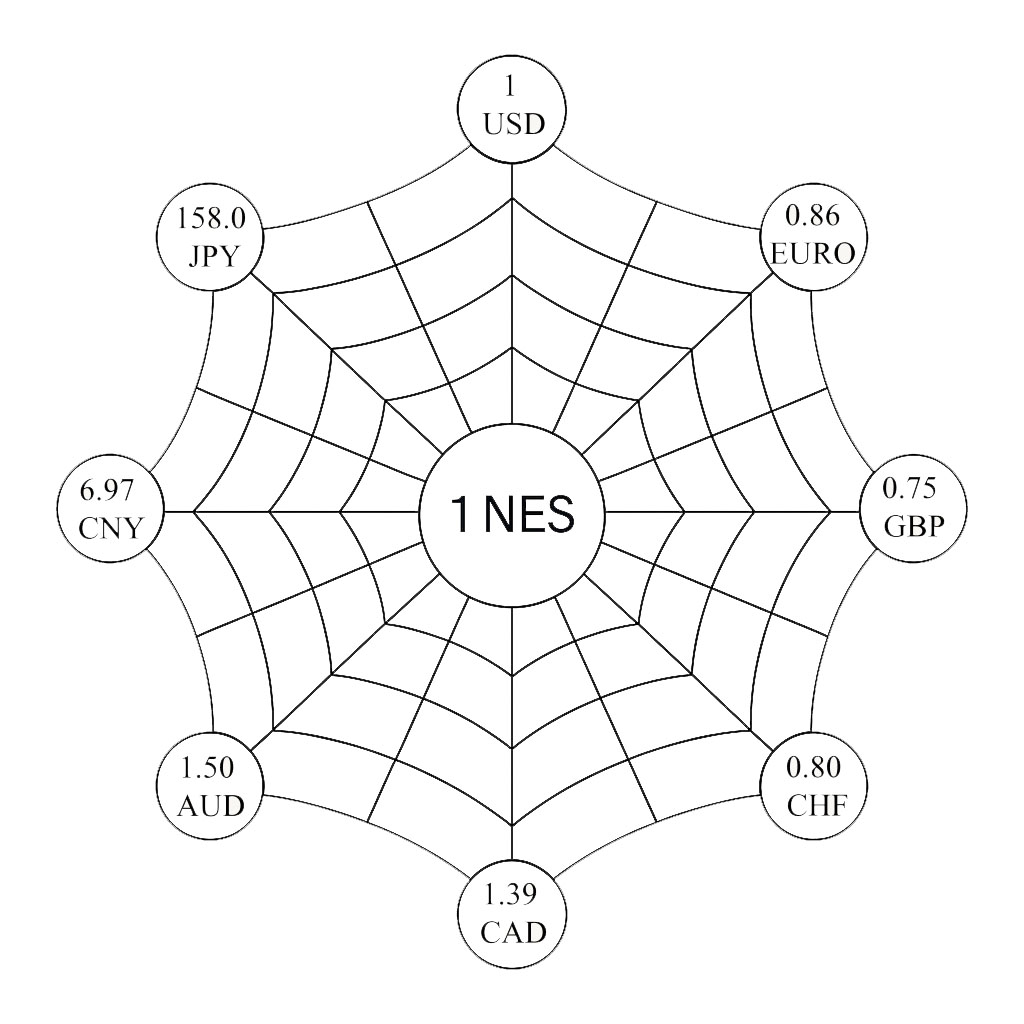
The NEMO Exchange Standard replaces the hierarchy of key currencies with a monetary web: each currency is linked to a central reference rather than to a dominant national currency.
This creates a monetary web rather than a pyramid. National currencies are no longer subordinated to one dominant currency. They are connected through a central standard that acts as a unit of account and clearing reference.
Such a system would reduce the need for countries to accumulate foreign-exchange reserves in dollars. It would weaken the privilege of the reserve-currency issuer. It would also reduce the geopolitical weaponization of payment infrastructures.
The objective is not to abolish national currencies. It is to change the way they interact.
Scriptural conversion and monetary destruction/creation
In the NEMO IMS framework, international payments would be handled through a scriptural mechanism of conversion, destruction and creation. When an import is paid, currency can be destroyed on one side of the transaction and created on the other according to the rules of the exchange standard.
This may sound radical, but it is conceptually simple. Money is not a commodity that must physically travel from one country to another. It is an accounting relation. International settlement can therefore be designed as a rule-governed transformation of monetary entries.
Such a system would make it possible to settle cross-border payments without relying on the perpetual accumulation of foreign reserves. It would also allow the system to encode ecological and social criteria directly into the rules of monetary circulation.
Transaction-based monetary demurrage
The second major innovation is monetary demurrage applied to transactions rather than to savings. Classical demurrage is often understood as a charge on holding money. NEMO IMS proposes a different mechanism: a monetary “melting” that occurs when transactions take place.
The basic rate may be modest — for example 1% — but it can be modulated according to ecological and social criteria. Low-impact activities face a low rate. Highly degenerative activities face a much higher rate, potentially 20% or more.
The point is not to punish individuals arbitrarily. The point is to make the monetary system recognize what the price system usually hides: ecological degradation, social damage, carbon intensity, resource destruction and systemic fragility.
In the current economy, a transaction that destroys ecosystems can appear profitable if the damage is externalized. In NEMO IMS, the monetary architecture itself would begin to re-internalize this damage.
Selective degrowth and monetary steering
NEMO IMS is not a system of general impoverishment. It is a system of selective degrowth and selective support.
Activities that undermine the living world should become more costly in monetary terms. Activities that repair, protect or strengthen the conditions of life should be made easier to finance. This is not merely a fiscal policy. It is a reorientation of the monetary infrastructure.
The goal is to shift the economy away from volume and toward quality, away from extraction and toward care, away from accumulation and toward robustness.
Overcoming the Mundell triangle?
The Mundell trilemma states that a country cannot simultaneously have a fixed exchange rate, free capital movement and autonomous monetary policy. But this trilemma assumes a monetary world organized around national currencies, capital mobility and exchange-rate defence.
NEMO IMS changes the frame. By replacing key-currency hierarchy with a central exchange standard and scriptural settlement, it reduces the need for each country to defend its currency through reserves and interest-rate policy. It does not magically abolish constraints, but it changes their nature.
The question is no longer: how can each country survive in a world of competing currencies? The question becomes: how can currencies be coordinated within an architecture that protects the living conditions of all?
A new role for central banks
In such a system, central banks would no longer be guardians of monetary neutrality only. They would become institutions responsible for systemic robustness. Their mandate would include price stability, financial stability, ecological stability and social robustness.
This does not mean that central banks should become political parties. It means recognizing that pretending to be neutral in the face of ecological collapse is itself a political choice. Monetary institutions already shape the economy. The real question is whether they continue to shape it blindly, or whether their power is aligned with explicit collective goals.
Why not simply use the IMF’s SDRs?
NEMO IMS is inspired partly by the idea of an international reserve asset, but it goes far beyond current SDRs. IMF SDRs are not a true currency used by citizens or firms. They are limited reserve assets allocated to states and central banks. Their allocation is constrained by geopolitical negotiations and existing quota structures.
NEMO Green SDRs would be different in purpose and design. They would not merely provide emergency liquidity. They would finance the ecological and social functions required for a viable civilization. They would be embedded in a broader exchange standard and linked to monetary destruction mechanisms that regulate flows according to impact.
The political condition
No monetary architecture can succeed without political legitimacy. NEMO IMS would require international agreement, institutions, measurement systems, democratic oversight and safeguards against capture.
This is a major challenge. But the current system also rests on political choices — only they are hidden behind technical language and inherited power structures. The question is not whether NEMO IMS is political. Of course it is. The question is whether we prefer an explicit politics of the living world to an implicit politics of extraction.
Conclusion: from international liquidity to planetary robustness
The twentieth century tried to solve the problem of international liquidity. The twenty-first century must solve a larger problem: how to organize money so that it no longer accelerates ecological overshoot.
NEMO IMS is not a finished institutional blueprint. It is a direction, a doctrine and a framework for debate. Its core intuition is simple: if money is a human institution, then it can be redesigned. If it can be redesigned, it must be redesigned around the conditions of life.
We do not need a monetary system that merely allows more trade, more debt and more financial circulation. We need a monetary system capable of financing the essential, discouraging the destructive and making ecological limits visible inside the architecture of exchange itself.
That is the purpose of NEMO IMS: to move from a monetary order of extraction to a monetary order of robustness.
← Article 3: A History of International Monetary Crises
Jean-Christophe Duval