
When we speak of “financial crises”, “trade imbalances” or “currency wars”, we are usually talking about the visible symptoms of a much deeper architecture: the international monetary system, or IMS. Most citizens never see it directly, yet it shapes the rules of the global economic game. It determines who gains and who loses from international trade, how countries finance their deficits, and whether national economies can remain stable or are pushed into repeated shocks.
To understand the IMS is to understand why some countries accumulate enormous foreign-exchange reserves while others remain permanently indebted; why exchange rates can move brutally; and why international monetary cooperation often looks less like a rational conversation than a geopolitical battlefield.
This article opens a four-part series on the international monetary system: its theoretical foundations, its structural dilemmas, its historical crises, and finally a radical proposal for redesign — NEMO IMS, the NEgentropic MOney International Monetary System, developed in my work on EQUILIBRIUM.
Definition and nature of the IMS
An international monetary system is the set of rules, institutions and mechanisms that govern monetary and financial relations between countries. It defines how national currencies interact, how trade imbalances are financed, and what constraints weigh on the economic policies of states.
Despite its technical name, the IMS is not a neutral convention reserved for central bankers. It is a political and economic infrastructure. It reflects geopolitical power relations, divergent national interests and historical compromises between dominant powers.
The current system, born from the Bretton Woods agreements of 1944 and transformed after their collapse in the 1970s, rests on several fundamental pillars.
The four pillars of the IMS
1. Currency convertibility
Convertibility determines the extent to which a currency can be freely exchanged for other currencies or for international assets. A fully convertible currency circulates without major restriction on foreign-exchange markets; a non-convertible currency remains largely confined within the borders of the country that issues it.
This is not a minor technical issue. Convertibility conditions a country’s capacity to attract foreign capital, finance imports and participate in international trade. Emerging economies often face what economists call “original sin”: they cannot borrow internationally in their own currency and must therefore take on debt in dollars or euros. This makes them vulnerable to exchange-rate movements and liquidity crises.
2. Exchange-rate regimes
An exchange-rate regime defines how the value of one currency is determined relative to others. Three broad categories can be distinguished.
Fixed exchange rates: the currency is anchored to a reference currency, often the dollar, or to a basket of currencies. The advantage is predictability; the cost is a loss of monetary autonomy and vulnerability to speculative attacks. Floating exchange rates: the exchange rate is determined by supply and demand on the foreign-exchange market. This offers maximum flexibility but can produce severe volatility. Intermediate regimes: managed floats, fluctuation bands, crawling pegs and other hybrid systems attempt to combine stability and flexibility, but they are often difficult to sustain over time.3. International liquidity
To trade abroad, countries need international liquidity: means of payment accepted beyond their borders. Historically, this function was performed by gold, then by national currencies turned into reserve currencies — sterling in the nineteenth century, and the US dollar since 1945.
Today the dollar remains dominant. It accounts for a major share of global foreign-exchange reserves and is used to invoice a large part of international trade, even in transactions that do not involve the United States. This gives Washington enormous economic and geopolitical power: the “exorbitant privilege” of the dollar.
The International Monetary Fund tried to create an alternative through Special Drawing Rights, or SDRs: an international reserve asset based on a basket of currencies. But SDRs never became the true foundation of global liquidity. They remain marginal within the world monetary architecture.
4. Adjustment and surveillance mechanisms
When a country accumulates a chronic trade deficit or sees its currency attacked by markets, how is balance restored? Adjustment mechanisms are the processes — automatic or negotiated — through which imbalances are corrected.
In the present system, adjustment relies mainly on exchange-rate movements for countries with floating currencies, or on austerity programmes for countries in difficulty. But these mechanisms are deeply asymmetric. Deficit countries are forced to adjust through recession, austerity or debt, while surplus countries face little pressure to rebalance.
The IMF and the World Bank play a role of surveillance and coordination, but their legitimacy is contested, notably because Western powers remain over-represented in their governance.
The Mundell triangle, or “impossible trinity”
The operation of any international monetary system is limited by a major economic dilemma formalized by the Canadian economist Robert Mundell: the incompatibility triangle, also known as the impossible trinity or Mundell trilemma.
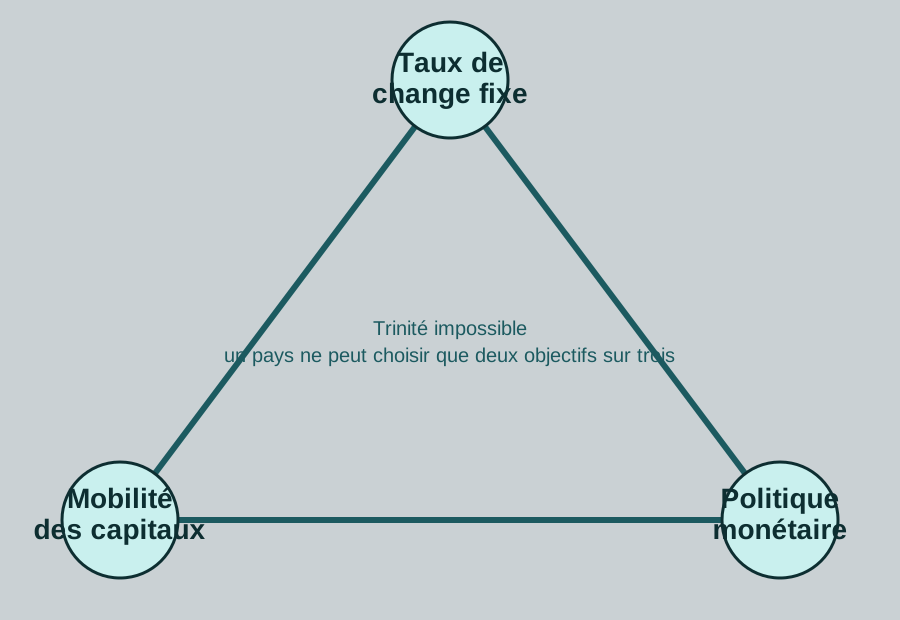
The Mundell triangle illustrates that a country can simultaneously achieve only two of three objectives: a fixed exchange rate, free capital mobility and autonomous monetary policy.
According to this triangle, a country cannot simultaneously achieve all three of the following objectives:
A fixed exchange rate: stability in the value of the national currency relative to a reference currency or to gold. Free movement of capital: no restrictions on inflows and outflows of funds. Autonomous monetary policy: the ability of the central bank to set interest rates independently in response to domestic economic needs.Each combination requires a sacrifice.
Fixed exchange rate + free capital movement = loss of monetary autonomy. The euro area is a clear example: member states gave up national monetary policy in exchange for intra-zone exchange-rate stability and capital mobility. Free capital movement + monetary autonomy = floating exchange rate. Countries such as the United States or Japan accept currency volatility in exchange for independent monetary policy and financial openness. Fixed exchange rate + monetary autonomy = capital controls. China long used this configuration, maintaining exchange-rate control while restricting capital flows.The Mundell trilemma is not a theoretical curiosity. It structures the strategic choices of every country and explains why there is no universal “optimal” monetary regime.
Conclusion: a system under permanent tension
The current international monetary system is a fragile assembly of historical compromises, geopolitical power relations and structural constraints. It rests on a dominant dollar, heterogeneous exchange-rate regimes and contested institutions of governance.
But beyond its technical dysfunctions, the IMS suffers from a deeper problem: it is disconnected from planetary boundaries. It contains no mechanism that rewards the preservation of natural resources, the reduction of CO₂ emissions or the regeneration of ecosystems. On the contrary, it amplifies the extractivist and consumerist logics that are driving us toward ecological collapse.
In the following articles, we will examine the concrete dilemmas of the current IMS, its turbulent history since the nineteenth century, and finally the proposal I develop through NEMO IMS: an international monetary system anchored not in debt and extraction, but in the regeneration of living systems.
The Mundell triangle tells us that we cannot have everything at once. But it tells us nothing about what we should want. That is precisely where the political debate begins.
Article 2: The Structural Dilemmas of the International Monetary System →
Jean-Christophe Duval