
During the Covid crisis, many of our leaders wondered what we would make of that ordeal. A few years later, while speculation has become the barometer of our societies' health, none of the problems concerning the real economy and its social and environmental consequences has been solved.
The reason for this deadlock lies in our inability to propose the institutional changes needed to reconcile economic, ecological and social questions. In particular, the implementation of our industrial policies has remained locked within a framework that has become unfit as environmental stakes have emerged.
This essay offers a reflection on the structural reasons that prevent this reconciliation, and focuses in particular on realigning economic incentives with the major environmental challenges now facing us.
I – Considering the bioeconomic proposals
Historically, modern economics built itself through successive emancipations from its attachment to the moral sciences. It was with what came to be called the neoclassical school (in the late nineteenth century) that it found, in rational mechanics, the epistemological and methodological foundations that were meant to bring it into the field of science. It thus became an increasingly abstract scientific discipline and formed the framework within which most of our representations of a "groundless" growth were built.
And yet, as early as the 1970s, this representation could have been questioned with the emergence of a cycle of crises (still ongoing) and the publication of the Meadows report (1972), which highlighted the links between activity, natural resources and demographics. A debate did open, but it was quickly closed by the genuine tour de force through which economists integrated into the standard model the increasingly obvious constraint of the degradation of the biosphere. By proposing the concept of "natural capital" as a representation of the stock of resources offered by the planet, on the same footing as labour and technical capital, nature was folded into the neoclassical theory of production, which became: Q = f(L, KT, KN)1. From then on, natural resources became perfectly substitutable with the other factors (provided markets function well). Consequently, if natural capital becomes scarce (hence a rise in its relative price), it becomes rational to replace it with one of the two other, now more competitive, factors in order to maintain the flow of production. With the question of planetary boundaries thus set aside, the prospect of continuous growth could return to the centre of forecasting models. It is this assumption of perfect substitutability that underpins what is called "technosolutionism", today regarded by standard economics as the miracle solution.
It must be acknowledged that, throughout this period, most economists ignored the lessons of The Entropy Law and the Economic Process [Georgescu-Roegen, 1971]. In that book, the author described the fundamental error of standard economic thought: economics was built within the mechanistic paradigm (Newton–Laplace), at a time when the emergence of evolutionary biology and the thermodynamic revolution were introducing other paradigms, transforming our vision of the becoming of nature, of irreversible time and of qualitative change within the economy.
Georgescu-Roegen's work rests on a physical vision of the production process, in which matter and energy occupy a central place. His three main propositions are: 1/ the production of goods and services rests on the transformation of flows of matter and energy; 2/ matter and energy are subject to the principles of thermodynamics; 3/ the theory of production belongs within a thermodynamic framework. Consequently, if thermodynamics forms the framework for renewing the theory of production, then that theory is subject to its two essential principles. First, the principle of conservation, which states that energy is conserved when it changes form (nothing is lost, nothing is created, everything is transformed). Second, the principle of entropy, according to which transformations move in the direction of a qualitative degradation of energy. Extending these principles to matter, Georgescu-Roegen proposed a new theory — bioeconomics — in which the economy is re-embedded within its physical environment (the biosphere).
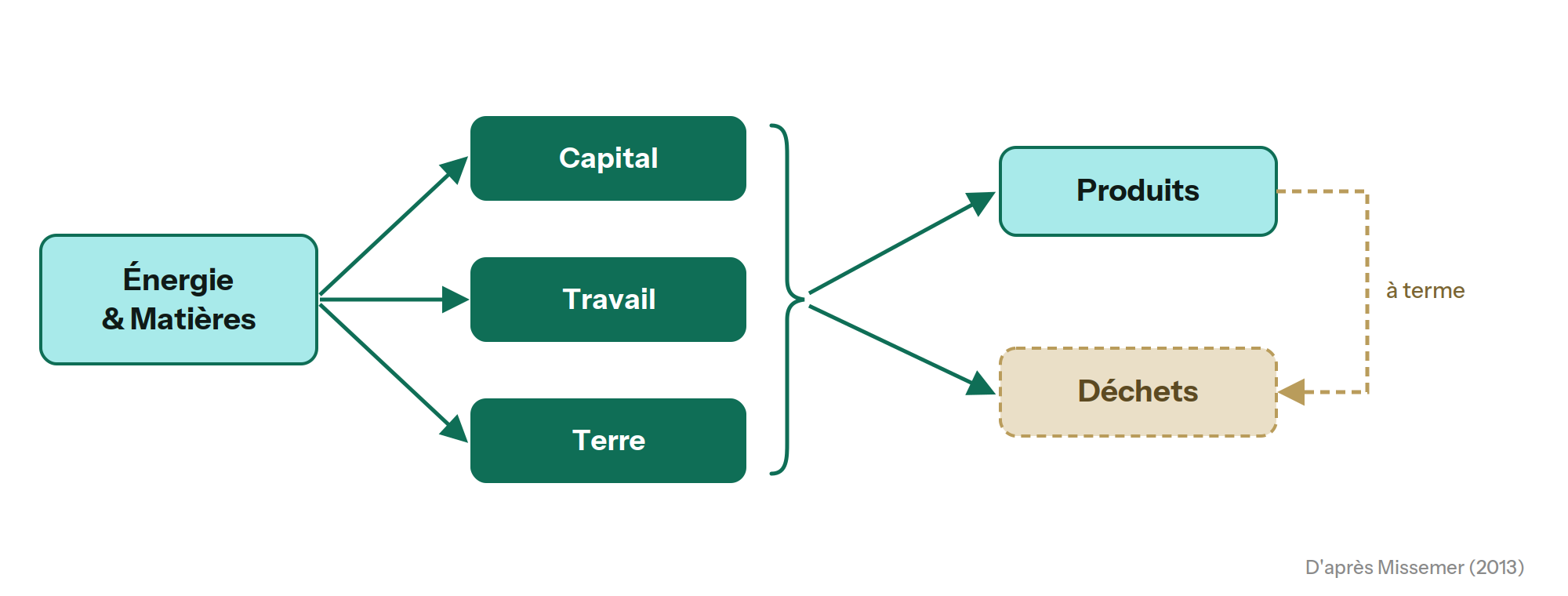
To propose a new production function "under the constraint of natural resources": his proposal distinguishes flow factors from fund factors. The flow factors are chiefly natural resources (R) on the input side, and products (Q) and externalities (W) on the output side. Under the entropic principle, these flow factors degrade qualitatively whatever form they take. The second kind — the agents of transformation — are land (T), technical capital (K) and labour (L). This new production function can be written as follows: Q = f(R, W ; K, L, T). Inspired by a proposal from Antoine Missemer (2013), we can represent it as shown above.
The key point of this methodological proposal is not simply to add physical flows to the traditional factors of production — capital and labour — but rather the vision of the relationship linking what Georgescu-Roegen calls flow factors and fund factors. In the bioeconomic production function, energy and materials are primordial resources, indispensable to the very existence of the means of production. To build technical facilities, it is preferable to have good-quality materials at competitive prices — the same holds for energy. Labour productivity depends in part on the conditions in which that labour is carried out (air, water, food, temperature, etc.). This leads to the conclusion that natural resources are not linked to the other factors by a relationship of substitutability, but of complementarity. Consequently, if some weaken, the others will suffer the consequences!
With the bioeconomic conceptual revolution, Georgescu-Roegen opens up new perspectives for adapting political economy to the realities of our physical world. The question no longer appears to be one of regulating the standard model, but rather of shifting towards a new productive model — a less entropic one.
II – From growth (producing more) to development (producing better)
By emphasising the biological nature of economic processes, Alfred Marshall had already perceived the need to take account of the advances of evolutionary biology, in particular when he pondered the concept of the industrial milieu. But this intuition was little taken up thereafter. Only Schumpeter, with his concept of creative destruction — akin to a process of mutation–selection — came close to it [Missemer, 2013]. Here again, it was Georgescu-Roegen who proposed placing economics in the footsteps of evolutionary biology. Within this framework, the economy cannot ignore what constitutes the very essence of biological phenomena — namely, changes in the nature and structure of organisms. Bioeconomics sets out to adapt these principles to the characteristics of the economy and to draw five main lessons from them [Bonaiuti, 2014].
1. A change in size within a biological structure entails a qualitative change in the form of the organism. Contrary to the claims of standard economics, the study of scale changes in social systems shows that the same observation can be made [Venet, 2019]. Consequently, and in a structurally different context, economic policy must not seek to restore a previous situation.
2. New kinds of properties emerge with each increase in complexity, and understanding these properties cannot be deduced from observing the lower level. When the context has changed (entering a post-growth situation, for example), modes of regulation must adapt.
3. Living systems seek a compromise between several goals. In the living world, once a certain size is reached, species and systems seek to regulate and stabilise their state. To do so, they act on several variables. Contrary to the sole maximisation of profit for the producer, in bioeconomic theory it is the pursuit of multiple goals that characterises the producer's rationality.
4. Competition alone is not the best solution for achieving goals. In a context of expansion, living systems generally enter into competition. In a stationary context, however, the search for balance will incorporate cooperation rather than mere confrontation. Contrary to the assertion of standard theory, in a stationary context pure and perfect competition does not necessarily produce optimal outcomes.
5. Living systems have the capacity to form a shared representation of their environment. This enables them to respond to various signals. Just like other living systems, but at a higher level of interpretation, social systems are able to use this information to carry out common actions aimed at modifying their environment (in a positive as well as a negative direction).
On these foundations, and to meet the immense challenge of our country's industrial rebirth, bioeconomics offers a powerful conceptual framework from which five major principles emerge, forming a method we shall call "permaindustrial".
- Replacement rather than increase. Slowing the entropic process will require replacing techniques, products and processes that have become unfit with solutions suited to the bioeconomic context. The permaindustrial firm thus develops a strategy of substitution rather than of increase.
- Renewing the producer's rationality. In a world that is ever less predictable and ever more complex, the firm will systematically seek the productive combinations that allow it to build the highest systemic added value (economic, social and environmental), rather than a mere maximisation of profit. In this approach, these forms of performance, far from being opposed, are complementary and combine to form a competitive advantage.
- Changing the level of analysis. Drawing on the concept of "adaptive competences" proposed by evolutionary biology, permaindustry posits that it is at the meso-economic level that industrial dynamics take shape and develop2. It is at this level, and collectively, that the new innovation frameworks guaranteeing collective performance are established. The permaindustrial firm favours the density and richness of interactions within the innovative milieu in which it operates.
- Circularising value chains. Against the linear and globalised approach, permaindustrial ecosystems favour a circular organisation that is as territorialised as possible.
- Technological and financial sufficiency. The specific status of energy and materials as primordial resources — and hence their non-substitutability within the production function — imposes a principle of sufficiency in their use. Consistent with the renunciation of the principle of acceleration, the permaindustrial model favours designing solutions that promote resilience rather than complexity, and sovereignty of use rather than dependence.
This permaindustrial model, which combines sovereignty, social cohesion and respect for environmental limits, appears to hold the characteristics needed to drive the industrial rebirth our decision-makers wish for. And yet it must be acknowledged that it occupies only a very modest place in our productive system today. The reasons for this strange situation are to be found in a system of valuation that continues to deny the entropic character of our economy.
III – Understanding the insurmountable contradiction of speculative technocapitalism
The physical dimension of the production process requires attention to the flows of matter and energy that make the final product possible. As a consequence of the first law of thermodynamics, its "natural inputs" will be found in the same quantity at the end of the process. But their form will have changed: because of the second law, they will end up in a qualitatively degraded form relative to the initial resources — eventually becoming either waste or pollution. This continuous and accelerated degradation appears as a major cause of the succession of crises that increasingly confront our growth ambitions.
The prospect of a soft landing seems to recede as the dominant economy continues to deny its entropic character. But can it understand this, when that same economy supported the advent of speculative capitalism from the early 1980s, dragging all our societies into the debt trap? This new form of capitalism rests on a radical change in the way the economy is financed, via the financial markets. Above all, money is increasingly diverted from the real economy to be invested in speculative activities — which led the Institut de recherche et d'informations socioéconomiques of Montreal to observe: "In financial logic, capital no longer has to take the detour through production in order to bear fruit; its mere circulation generates the creation of fresh capital. (…) It is speculation that raises the value of an asset." Now, speculation and economic acceleration are intimately linked. The higher the amounts to be repaid, the more growth is required to do so.
This principle of acceleration shapes a new form of economic organisation. Traditionally, to grow rich in business one had to build a firm that would generate profits, which would then be shared with shareholders. Nowadays, becoming a profitable firm has become an optional step: venture capitalists and founders no longer even try to create durable projects — their aim is to build a promise that will find a buyer. The start-up model is emblematic of the principle of debt acceleration that characterises this new world. This same principle of acceleration is found on the consumption side, which explains the introduction of new technologies designed to save us time [Vignes, 2021]. All in all, when rhythms reach such a speed, human beings can no longer keep up; it is then the machine's turn to enter the game. Thus acceleration justifies the advent of new technologies (previously useless) such as AI. But these investments are very costly, so one must borrow ever more to keep up the pace. The loop is closed.
Yet, in a thermodynamic context, this acceleration is not sustainable. Can we count on the rationality of agents to take the decisions that are called for (that is, to slow down)? Obviously not, because firms are trapped by debt. The rational decision is to keep growing, ever faster, to generate ever more cash flow in order to repay creditors and reward shareholders. They cannot do otherwise, because few incentives lead them to act differently. Jean-Christophe Duval (2026), taking up Ronald Coase's argument, reminds us that the producer's rationality will always lead it to grow (and therefore to pollute) because that is the least costly way to produce and to manage its waste, within a price system that never charges for the entropic process! The environmental crises that are now our daily reality are the rational consequence of a price system that renders entropy invisible — or rather, that transfers its costs to public authorities. The latter must then borrow ever more to bear them. This is how the most entropy-generating projects (oil, giant data centres, AI, etc.) are also the ones that attract the most capital. To put it another way, the highly entropic linear economy will structurally always be more profitable and more competitive than the permaindustrial economy (with its lower impact).
Overcoming this contradiction — which gives the producer an interest in polluting rather than in being virtuous — appears to be the great question posed to our economic policies. Answering it will necessarily require putting in place an incentive mechanism capable of steering producers towards solutions aligned with environmental stakes.
IV – Aligning economic incentives with environmental integrity
In the era of industrial capitalism, financial capital was scarce. Fifty years later, the nature of scarcity in the economy has radically changed. Financial capital is now superabundant, while natural resources are dwindling ever faster. We must take note of this and put this new financial abundance at the service of the existential challenge that is the re-embedding of the economy within its natural environment. This project is at least as transformative as the great financial deregulation launched by Ronald Reagan's United States in the early 1980s. It is a long-term project, one that calls for decisions at least continental, if not global, in scope. Urgency cannot accommodate such delays, which is why — to set the movement in motion — we propose a pragmatic method that begins by using an existing tool: the voluntary carbon markets (VCM), positioning them as a first-rank financier of new "low-entropy" value chains.
To do so, these VCM will need to strengthen their credibility in terms of environmental integrity and give a significant place to industrial models committed to reducing emissions at source.
i. Restoring trust in the voluntary carbon markets. This market can be seen as a framework in which a demand for emission reductions meets a supply of emission reductions. It thus concerns all those who, in one way or another, have an interest in reducing greenhouse gas emissions. What is traded on this market is a financial instrument: the carbon credit (CC), corresponding to 1 tonne of CO2eq sequestered or avoided. These markets have grown rapidly, driven by climate-neutrality commitments. But today their environmental integrity is questioned by numerous studies [AFD, 2025; Chen Teo et al., 2023; Guizar-Coutiño et al., 2022; A.-P. West et al., 2020]. The cause is the strong uncertainty about the real environmental value of the projects that generate CCs. Yet that value determines the price which, as in all markets, establishes the link between buyers and sellers. Moreover, this value is weakened by the uncertainty surrounding climate policies. In sum, and as things stand, buyers and sellers are incentivised to favour cheap CCs even where the impacts of the projects concerned are limited, uncertain over time and hard to measure. Thus the market tends to crowd out credits of higher environmental quality (and therefore more expensive) in favour of lower-quality but cheap credits, which gradually become dominant — eroding overall trust. To restore that trust, it seems necessary to act on the three main weaknesses of these markets.
The first is tied to the very design of the market. Most of the CCs traded are based on uncertain baseline scenarios, and their complex biophysical characteristics make them difficult to assess against the main integrity criteria such as additionality, verification and permanence [AFD, 2025]. The second stems from the fact that, on these markets, information asymmetry is structural, which makes the quality of CCs hard to observe, both before and after the exchange. What airline customer worries about the reality of the reforestation to which they will have contributed? Moreover, the buyer and its business model are rarely affected by the failure of the good acquired, which limits their incentives to demand high quality. The third originates in the globalised — and above all already financialised — character of these markets. Intermediaries operate on them, preventing any relationship between the suppliers and the demanders of emission reductions. In these markets, marked by inconsequence and distance, sellers and intermediaries have an interest in maximising the volumes traded, not necessarily the quality of the credits.
It therefore seems clear that the design of these markets cannot be reduced to the neoclassical framework, whose assumptions — perfect information and certain anticipation — are inoperative. It calls for a deep institutional reconfiguration aimed first of all at bringing them closer to the "real economy". This reconfiguration must favour the legibility of the link between buyers (CO2 emitters) and sellers (CO2 savers) and belong to a logic of cooperation in the service of a general interest (the industrial sovereignty of a territory, for example). From this perspective, the creation of territorialised and interconnected carbon markets appears as a path capable of restoring the trust weakened by the low quality of the credits traded, and above all of re-anchoring them in national and territorial public-policy objectives. Like the carbon cooperatives now emerging in France, the development of carbon exchange platforms linking, in close proximity, the demanders and suppliers of emission reductions should correct some of the current weaknesses (integrity, inconsequence, intermediation, information asymmetry).
Besides suppliers and demanders, the participation of the various stakeholders (public and private) in the governance of these platforms would help ensure coherence between these markets and local policies. Furthermore, since the development of these institutions is tied to the local industrial system's capacity to generate ever more high-quality CCs, these platforms would have a major role to play in developing permaindustrial value chains within their territory.
By supporting low-entropy activities, these territorialised VCM would thus form an institutional response to the sufficiency challenges of our productive activities. But the relevance of this response rests on another transformation, internal to these markets: that of the hierarchy of decarbonisation solutions.
ii. Favouring avoidance solutions to treat the carbon problem at source. To date, carbon-emission accounting falls within the following three perimeters (scopes):
- Scope 1: the firm's direct emissions.
- Scope 2: indirect emissions related to energy.
- Scope 3: other indirect emissions (within the value chain).
It should be noted that in all three cases, it is the processes (more or less polluting) that are examined, and in no way the more or less entropic character of the solution the firm puts on the market. Thus, at the extreme, a firm whose business model (ultra-disposable, say) is itself a driver of high entropy could show great progress in carbon emissions — by changing its process, for instance — while accelerating the marketing of low-durability products, ever more numerous and therefore generating ever more waste or pollution of all kinds. This is precisely the object of the current dispute pitting the courts against the TotalEnergies group over the accounting of its customers' CO2 emissions.
To overcome this problem, for a few years now — at the initiative of the GHG Protocol — the idea of a Scope 4 tied to the use of low-carbon goods and services has emerged. It concerns emissions avoided through the use of a product with a low entropic impact in replacement of another with a higher impact. In this framework, it is the users of the solution who see their emissions fall relative to those they previously produced. Complementary to the actions firms implement to reduce their direct and indirect emissions, these solutions bear on the firm's own offering. Above all, compared with the logic of sequestration, this solution does not seek to correct a problem, but prevents it from arising.
In this approach, the firm is seen as an actor responsible for the solutions it produces and markets. In this sense, the concept of avoided emissions appears more systemic and more transformative. The current weak recognition of this carbon-avoidance logic is often justified by methodological questions of calculation and of compliance with integrity criteria. We believe that on both points this claim is questionable. Compared with sequestered emissions, avoided emissions appear far more robust to assess because, by definition, the emission reduction is established by comparison with an existing situation (the one that will be replaced), which is not the case for the sequestration configuration, which reasons on a hypothetical baseline scenario. As for the integrity criteria, none seems to pose insurmountable problems. Additionality is respected, in the sense that without the mobilisation of CCs the new solution would hardly be competitive, as we showed above. Likewise, the permanence and verifiability criteria should pose no particular difficulty, since these are industrial solutions that can be documented and audited at any time. Let us add another comparative advantage: carbon avoidance has an immediate effect (the carbon is not sent into the atmosphere), whereas sequestration projects produce their effects only several years — indeed several decades — later. One last point seems important to us: that of the rebound effect, which could offset the primary benefits of avoidance. This is precisely where the whole interest of the permaindustrial model lies, since by nature it is built on a vision of replacement rather than of increase.
In France, the third phase of the national low-carbon strategy (SNBC 3) defines a trajectory for reducing greenhouse-gas emissions until carbon neutrality is reached in 2050. Meeting these objectives, which become ever more binding over time (a 5% reduction in emissions per year), requires activating various levers — among which these new territorialised VCM must feature, capable of circulating money between the demanders and suppliers of emission reductions, united in the ambition to develop solutions liable to slow the entropic effect inherent in industrial activities across a given territory.
Present everywhere across our territory and interconnected, these new-generation VCM could have a far broader, far more systemic influence — and above all one far more capable of realigning local economic policies with environmental stakes than many economic policies that remain locked within an outdated neoclassical model.
Notes
Bibliography
- (2025). Marchés carbone : quels rôles pour les acteurs publics, privés et multilatéraux ?, technical report.
- (2011). From Bioeconomics to Degrowth. Georgescu-Roegen's "New Economics" in Eight Essays, Routledge Studies in Ecological Economics.
- (2023). Uncertainties in deforestation emission baseline methodologies and implications for carbon markets, Nature Communications.
- (2026). L'Économie de l'équilibre. Monnaie, finance et limites planétaires, Debunk'Onomy.
- (1971). The Entropy Law and the Economic Process, Harvard University Press.
- (2022). A global evaluation of the effectiveness of voluntary REDD+ projects at reducing deforestation and degradation in the moist tropics, Conservation Biology.
- (1972). The Limits to Growth, Chelsea Green Publishing.
- (2013). Nicholas Georgescu-Roegen, pour une révolution bioéconomique, ENS Éditions.
- (1942). Capitalism, Socialism and Democracy, French ed. Payot, 2025.
- (2019). La désindustrialisation comme vecteur de vulnérabilité territoriale, Populations vulnérables, OpenEdition Journals.
- (2019). L'Impasse. Étude sur les contradictions fondamentales du capitalisme moderne et les voies pour les dépasser, Citizen Lab.
- (2021). L'accélération technocapitaliste du temps. Essai sur les fondements d'une économie des communs, Éd. R&N.
- (2020). Overstated carbon emission reductions from voluntary REDD+ projects in the Brazilian Amazon, PNAS.
Renaud Vignes